 Matthew Goetting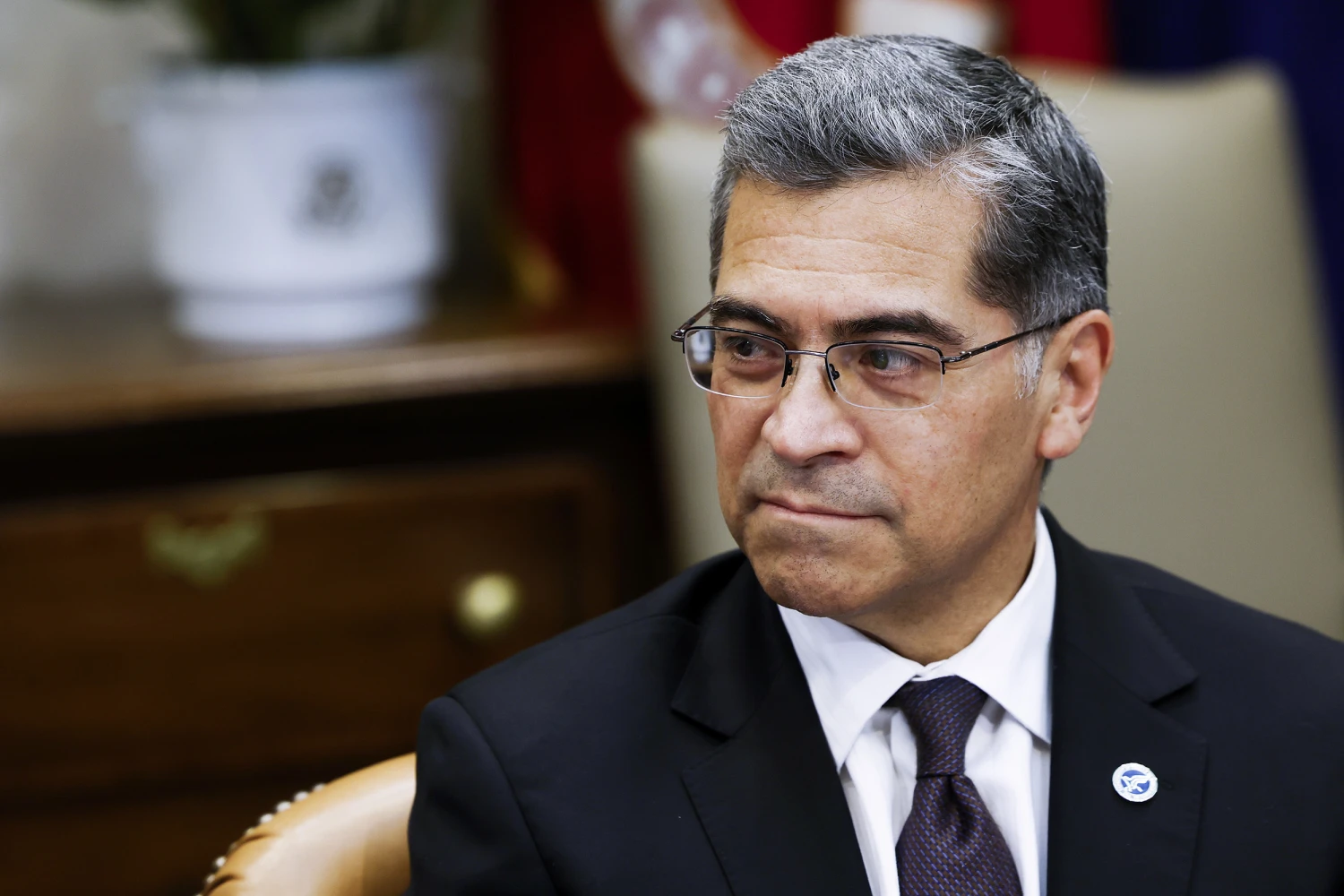
I was checking on the California governor's race when I saw Xavier Becerra was the frontrunner. A month ago he was polling at 4 percent.
Becerra is an odd candidate for this type of surge. He doesn't have the public salience of say, a Porter or Steyer, and even as someone who avidly follows politics, his name only vaguely registers as "that guy who was Biden's HHS secretary." When Swalwell dropped out, Becerra absorbed most of the vacuum, jumping to the polling lead with $2.9M in the bank, less than basically every other relevant figure in the race.
Frankly, I don't think he stood out in either debate. There was an awkward KTLA interview where he was argumentative and opened by asking the anchor whether it was a gotcha piece. His longtime chief of staff pleaded guilty to corruption charges, and though Becerra was cleared, it's not a great look. He's also not very popular in Bidenworld.
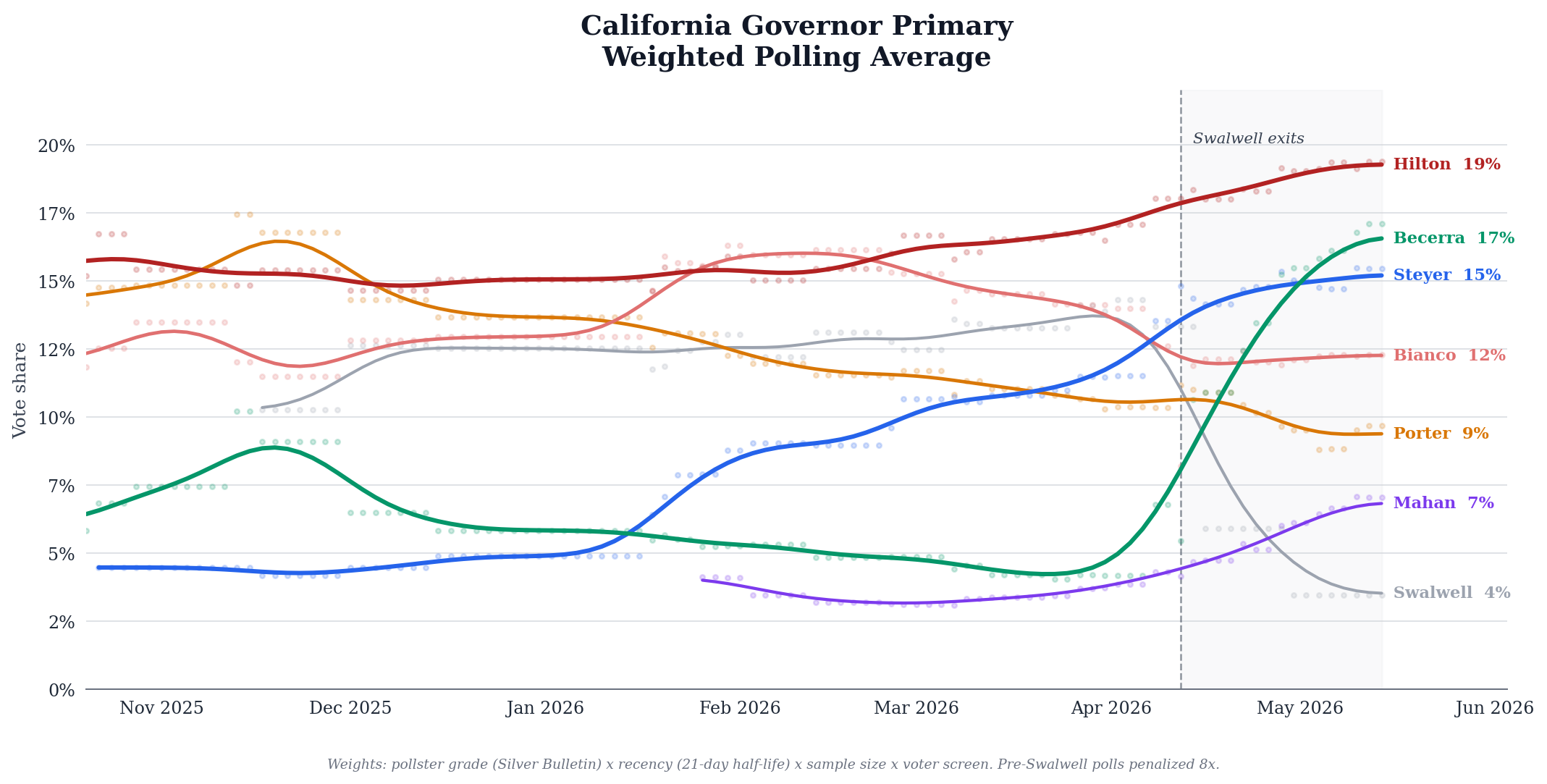
So lesser name recognition, thin funding, no obvious debate momentum, some bad press, and somehow the rapid rise to frontrunner? Prediction markets are pretty good at this stuff, so the price is probably right, but I was curious.
Methodology
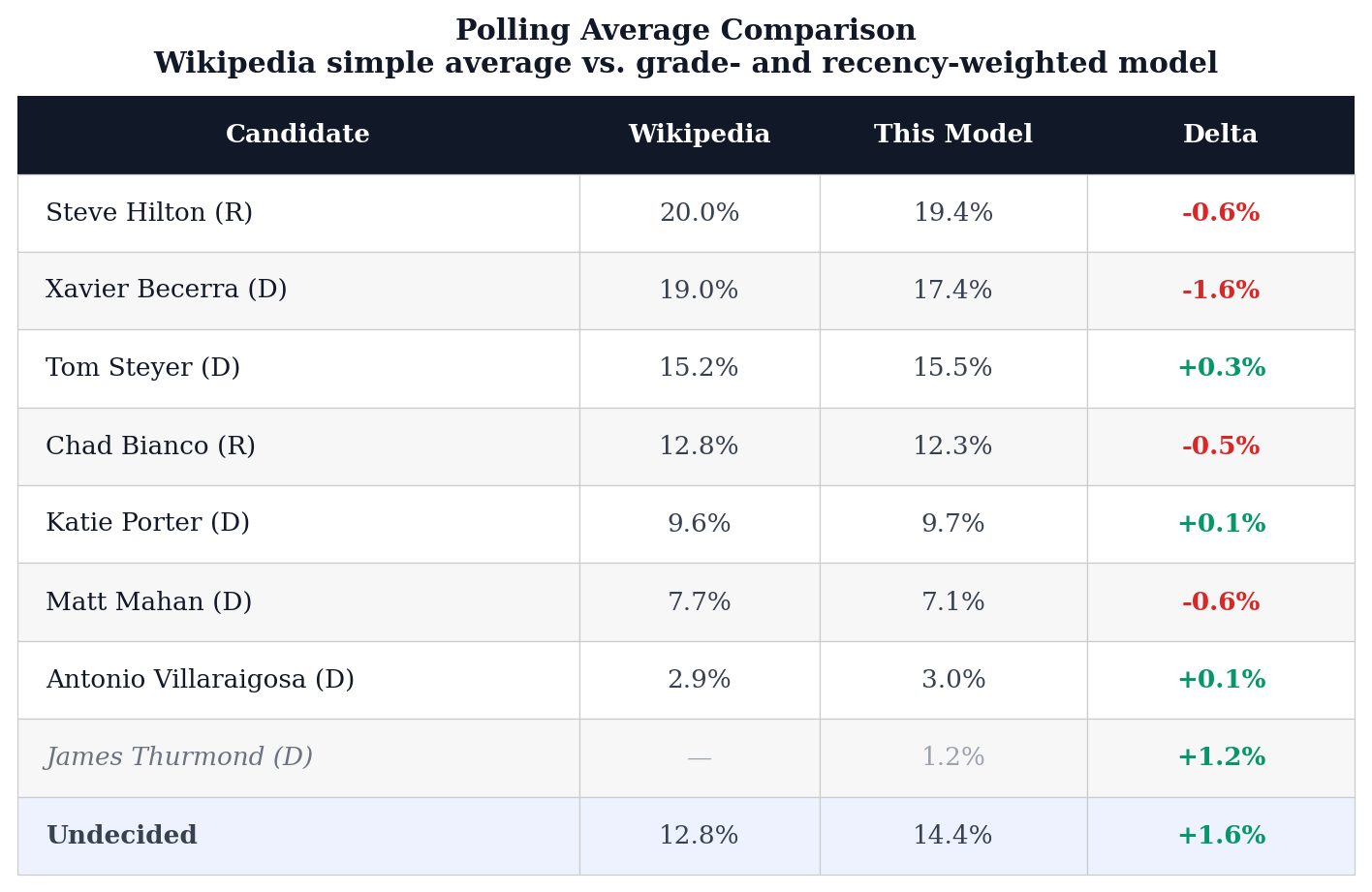
I aggregated the post-Swalwell polls, weighted by pollster reliability and recency, with a small adjustment for historical pollster bias using Nate Silver's pollster stats. That gave me a baseline of Hilton at 19.4, Becerra 17.4, Steyer 15.5, Bianco 12.3, Porter 9.7, Mahan 7.1, and undecided 14.4. Nothing exotic. If anything, my baseline is a little more favorable to Steyer relative to Becerra than other aggregations are, mostly because SurveyUSA and CBS News/YouGov, both heavily weighted A-rated pollsters, differed from consensus with Becerra at just 10 and 13 percent respectively.
I'm not an election forecaster. I don't think I have much edge in turning these polls into a full prediction from first principles. So I treated the Kalshi winner prices as roughly fair and tried to reverse-engineer what the markets must be implying. The model starts with my polling baseline and simulates possible election-day outcomes, allowing the polls to be wrong in a few different ways:
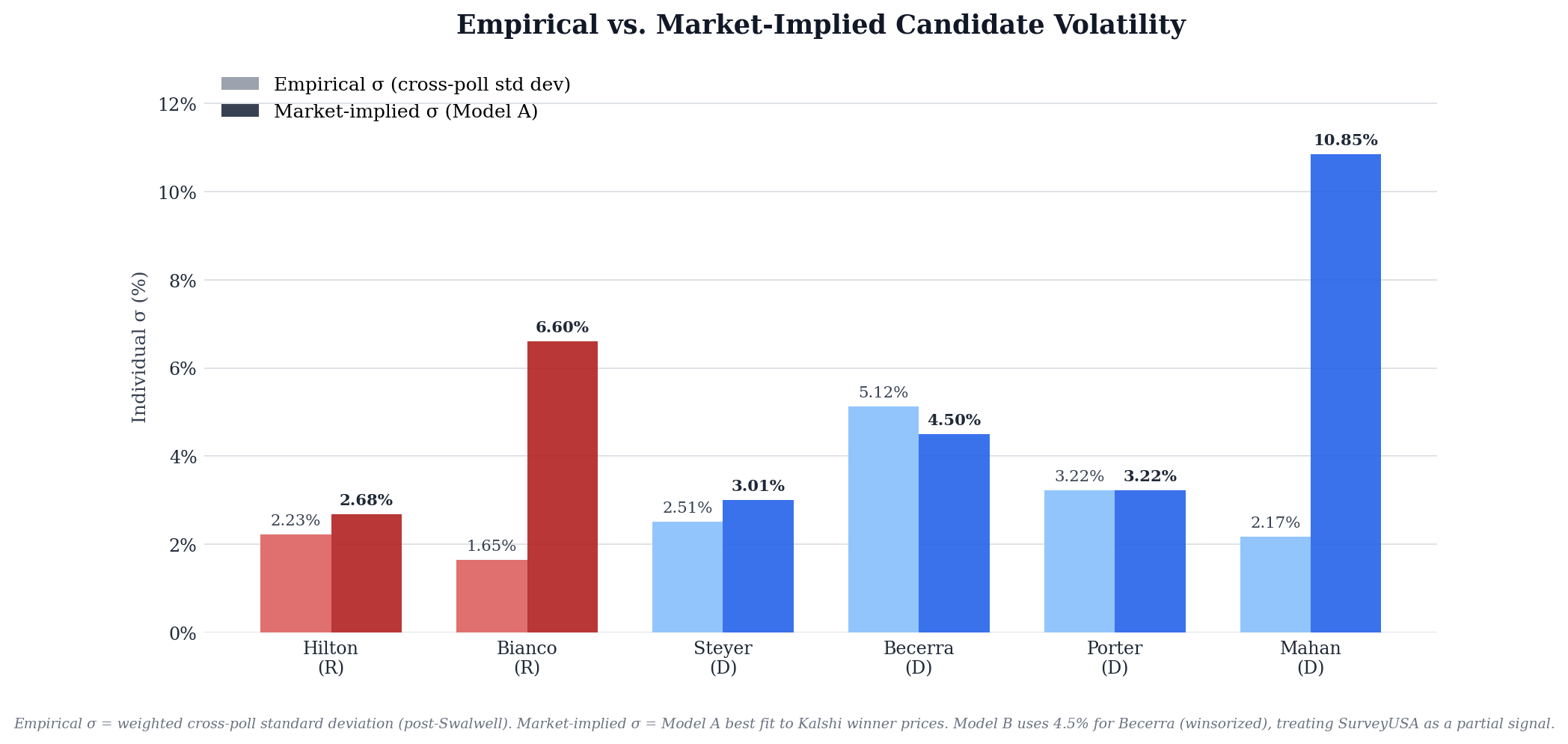
- Candidate-level volatility (σi): The uncertainty around each candidate's own vote share. A candidate polling at 20% with σi = 3% lands between 17 and 23% in a one-standard-deviation outcome. Any candidate who lands below zero gets assigned zero and then the whole vector renormalizes.
- Party-level shock (σp): What happens if the polls are systematically wrong about Democrats or Republicans as a group. Think 2016, when basically every poll missed the Republican vote share in the same direction. A single party shock is drawn once per simulation and applied identically to all candidates in that party, so if Democrats are up, they're all up together. Cross-party correlations stay near zero, though normalizing to sum to 100% introduces small mechanical negative correlations across everyone.
- Consolidation: Some of the vote currently sitting with Porter, Mahan, Villaraigosa, and the rest of the field might drift toward Becerra or Steyer before June 2. I assumed roughly proportional redistribution, given that Mahan and Villaraigosa voters skew toward Becerra, fitting their pragmatic establishment lane, with some of Porter's voters skewing Steyer.
The model also needs November matchup probabilities. What happens if it's Becerra versus Hilton, or Steyer versus Hilton, and so on. I have no good way to forecast these independently, so rather than guess, I let the model solve for everything jointly. I set some realistic bounds like, a Republican can have no more than a 15% chance of beating a Democrat in the general (CA is D +20). The 14% of undecided voters are distributed proportionally to current vote shares each simulation, with some noise, a Dirichlet draw.
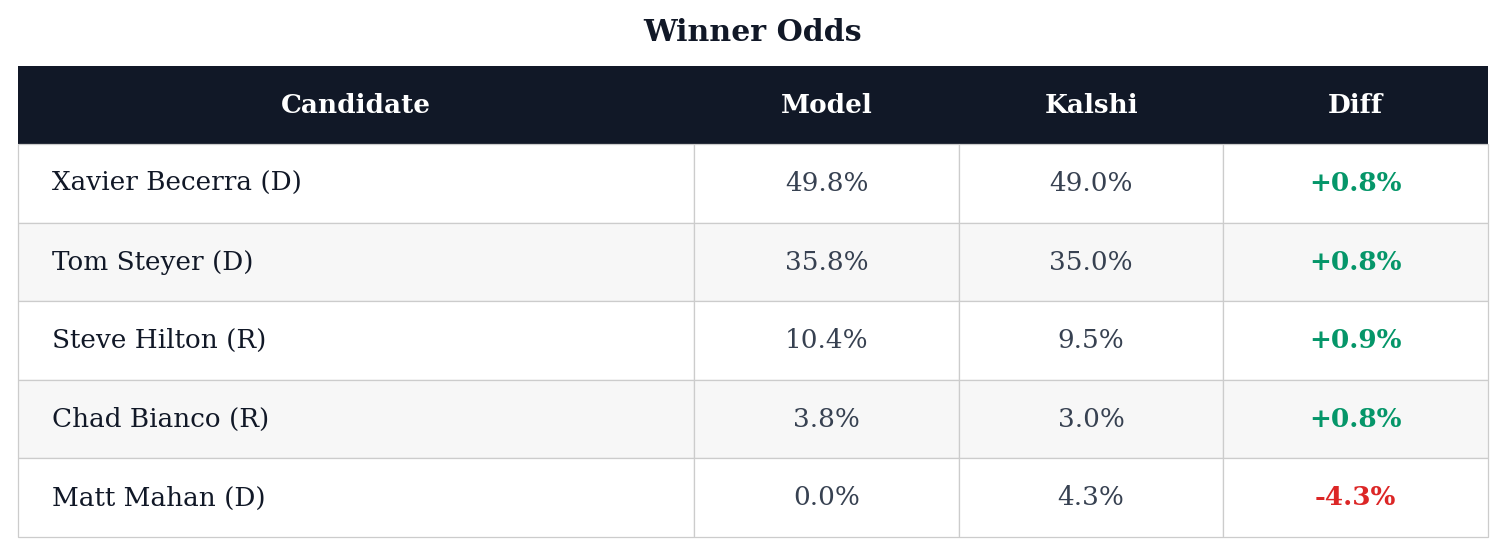
What set of parameters is most consistent with Becerra at 49, Steyer at 34, Hilton at 9.5, Mahan at 4.3, Bianco at 3?
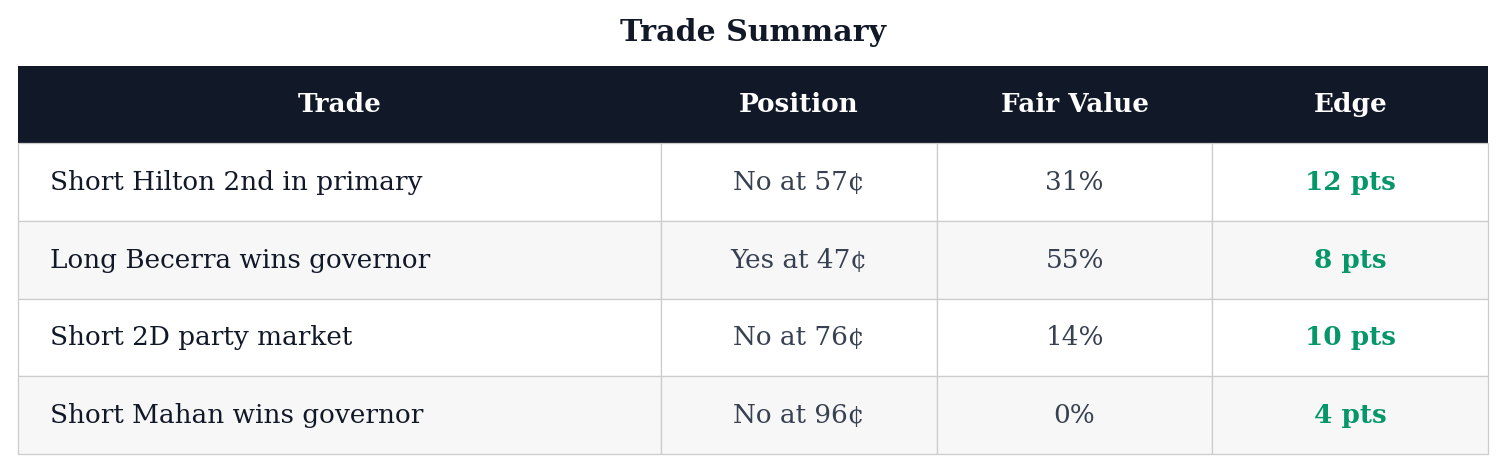
Mispricing 1: BUY Mahan NO at 96.0c
Fitting Kalshi's winner prices requires assigning Mahan a σ of 10.85%, which is roughly five times his empirical level. Empirical volatility just means how much a candidate's numbers have actually moved across polls. Mahan has never broken 10%, so for him to have a 4.3% chance of becoming governor, the market is pricing in a solid chance he surges to 18–20% on election day. There's no polling basis for that.
When Mahan lands at 15–18% in a meaningful fraction of draws, he crowds Bianco out of the top two. To keep Bianco's odds near 3%, the optimizer also inflates Bianco's volatility. But this creates an internal mispricing. When Mahan surges, he's mostly displacing Becerra or Steyer rather than Hilton, who is polling higher with lower volatility. That pushes more scenarios toward a D-R outcome and fewer toward D-D, so the two-Democrat probability drops to around 21–22%, below Kalshi's 25%. And Bianco's inflated vol pushes the two-Republican outcome to 8–9% rather than Kalshi's 5.6%.
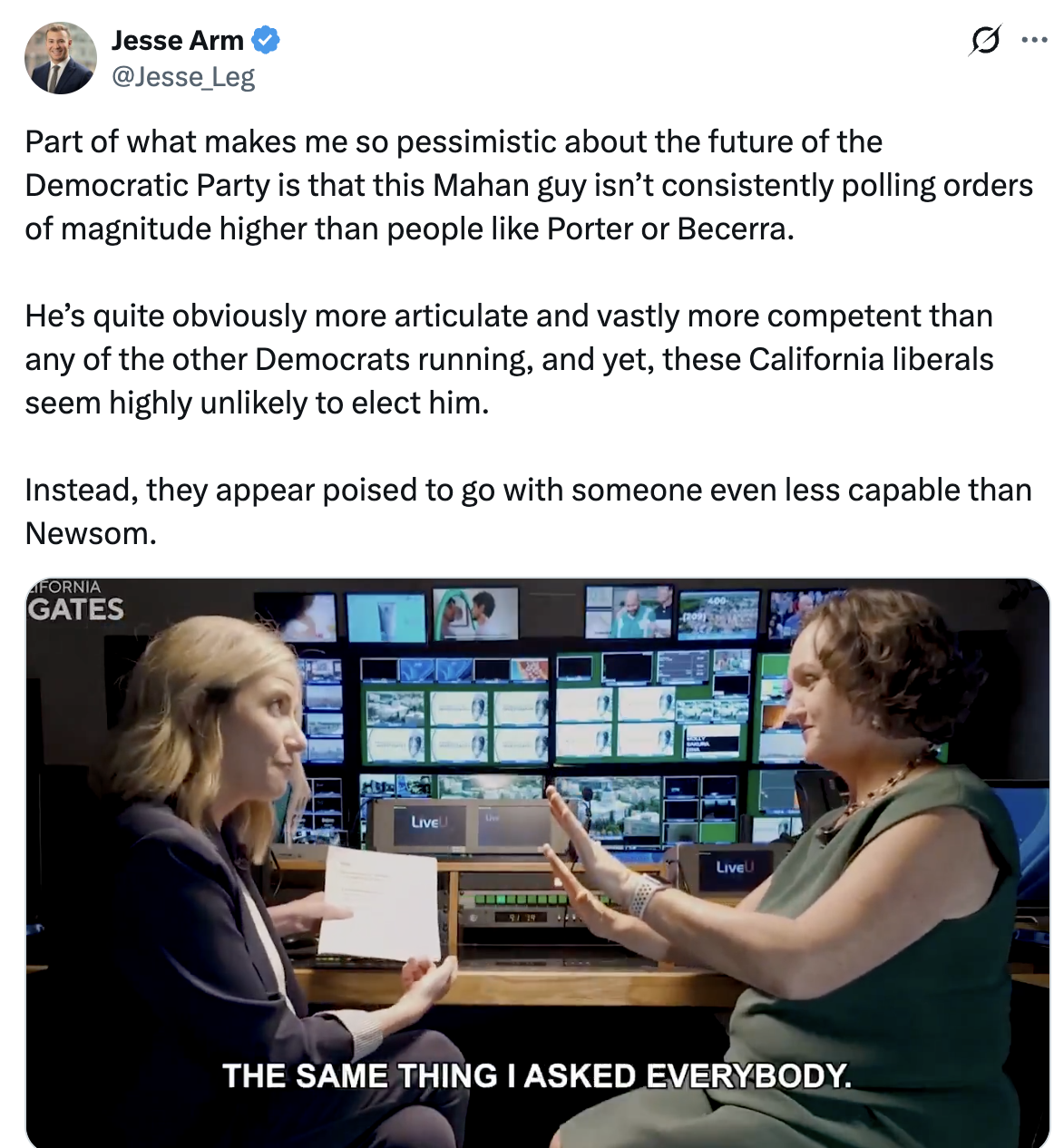
But my take is that Mahan's fair value is much closer to zero. I think he's overpriced for two reasons. He fits the profile Kalshi traders tend to be a bit biased toward: young mayor, moderate, technocrat pragmatist. And small probabilities just tend to get a bit overpriced on prediction markets. You can buy hundreds of NO shares at 96.0 cents. That's 4% on top of the risk-free rate, since Kalshi holds your collateral in treasuries until November.
Mispricing 2: BUY Becerra YES at 49.0c
Since pure market-implied volatility can produce these absurdities, I built a second model that blends it with empirical volatility. For each candidate, I compute the effective sample size of the polling data, which captures how much independent information the polls actually contain after weighting, then I shrink each candidate's σ toward the market-implied proportionally. The result fits every candidate's Kalshi price within about 1%, except Mahan, who cannot be fit at any reasonable volatility assumption. Best-fitting parameters were consolidation = 5% and σp = 2.5%.
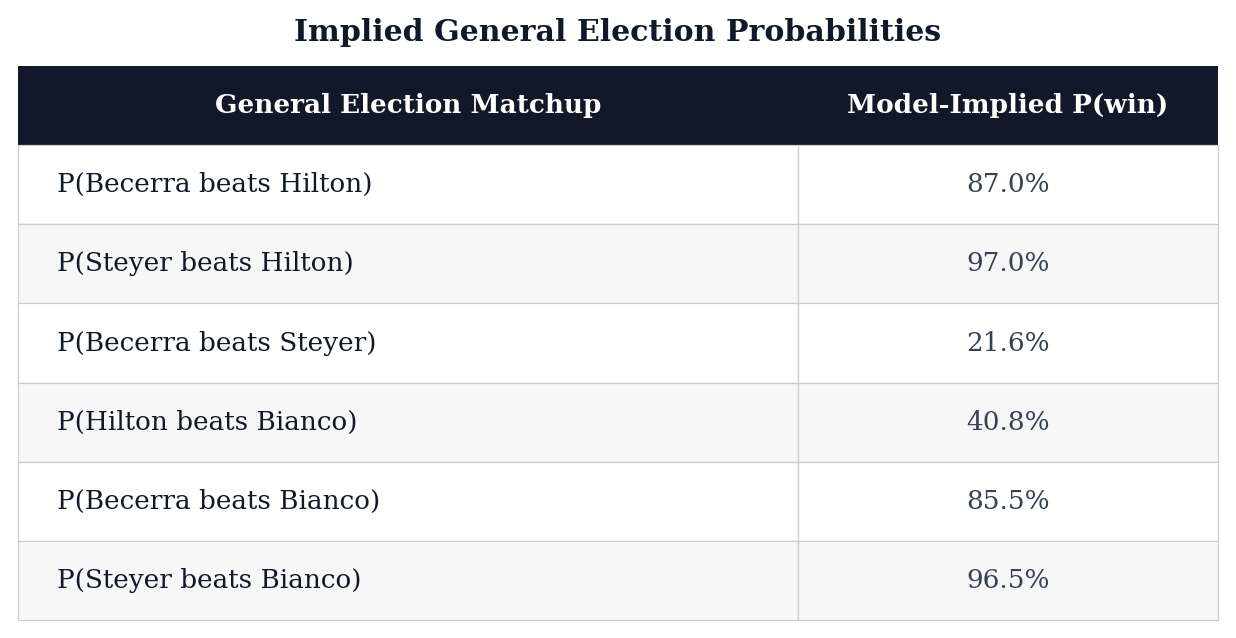
Looking at the implied general election probabilities, P(Becerra beats Hilton) at 87%, P(Steyer beats Hilton) at 97%, P(Steyer beats Bianco) at 97% all look reasonable for California. A bit harsh on Becerra relative to Steyer against Republicans, but perhaps there's an argument for that. P(Hilton beats Bianco) at 41% might be a touch low given Hilton's polling lead and Trump's endorsement, though an R-R general would be pretty unprecedented and maybe Trump's endorsement backfires. I'm not going to die on that hill.
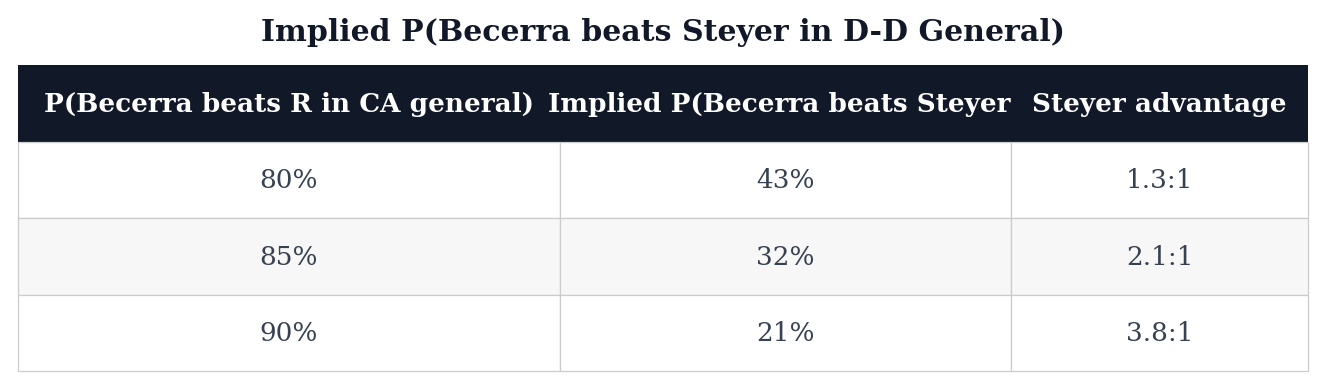
The one number I can't defend is P(Becerra beats Steyer) = 21.6%. At first I was worried this was a model quirk. Then I checked Kalshi's own matchup market. Becerra faces a Republican 52% of the time and Steyer 28%. So:
P(Becerra wins) ≈ 0.52 × P(Becerra beats R) + 0.28 × P(Becerra beats Steyer) ≈ 49%
For any realistic D-R win probability in California, this equation requires Steyer to be somewhere between a 1.3:1 and 3.8:1 favorite over Becerra in a head-to-head November general. And since two independent sources point to this conclusion, I'm pretty convinced the market is pricing in Becerra as a massive underdog if both Democrats make it through.
But I vehemently disagree. I know I started off bashing Becerra. I don't think he's an electric candidate! But voters swung to him over Steyer after Swalwell's exit for some reason, and he's been polling ahead ever since. He'd be the first Latino governor in California history, with a November general electorate that's way more Latino and working-class than the June primary crowd. He's won statewide before as AG. And Steyer's financial edge isn't as strong in a general election where more resources are available. And, since this is a general election, I think Republicans and Independents would lean mainstream establishment Democrat over billionaire progressive campaigning on a climate platform.
So if you think Becerra is a coin flip or even 60-40 rather than a 3.8:1 dog, his fair value is closer to 58c. At 49c, I think he's worth buying. And by the same logic, NO on Steyer is also +EV.
Mispricing 3: BUY 2 Democrats NO at 76.0c
Kalshi's party market prices a two-Democrat runoff at 25%. My model puts it at 14%. This is where I'm most willing to grant Kalshi might have a point. The argument is that Democratic enthusiasm is underpolled: the primary is contested and exciting on the Democratic side while the Republican race is essentially settled, which could mean Democratic turnout runs a few points higher than historical models assume.
But I think the magnitude required is just unrealistic. To close that 11-point gap would take a correlated Democratic party shock of roughly 6–7 points, comparable to the 2016 national polling miss, in a state where the historical D/R polling gap has been pretty small.
Mispricing 4: BUY 'Hilton 2nd Place' NO at 57.0c
Quick clarification on what this market actually is. The Hilton 2nd place contract resolves YES if Hilton receives the second-highest vote count in the June 2 jungle primary, not if he's the runner-up in November. It's purely about who gets the most raw votes on June 2 across all candidates.
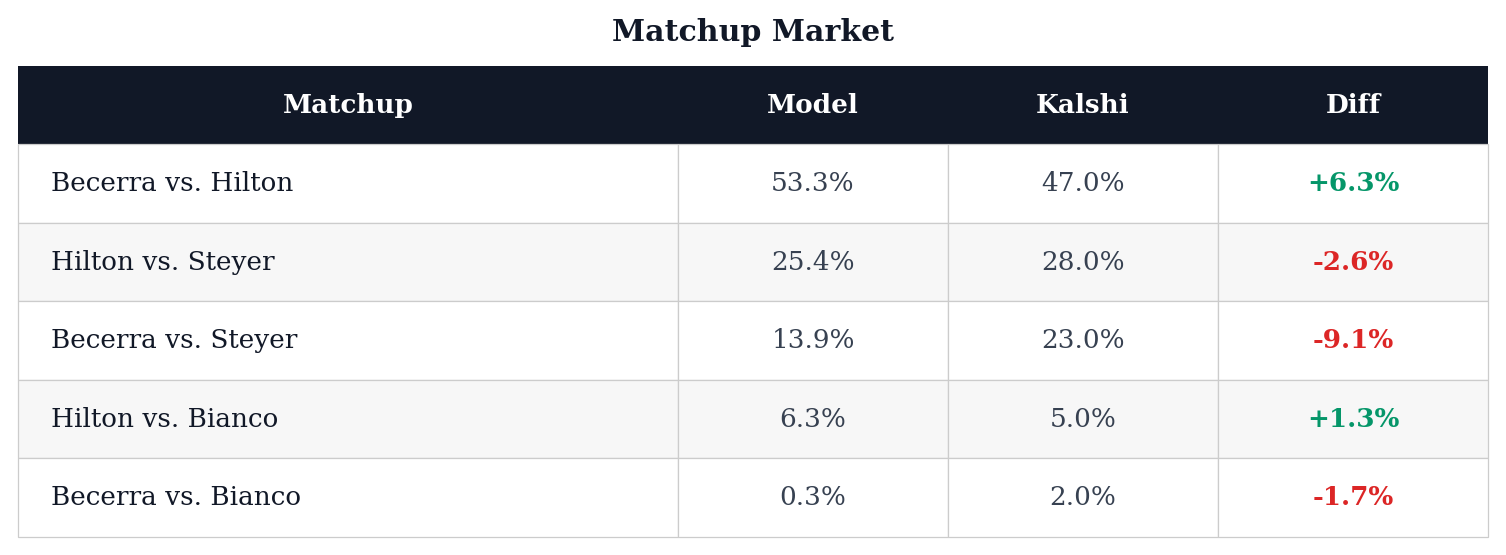
Adding up all the matchup probabilities that include Hilton gives a raw total of 80% to make the November general election. My model puts it at 85%. The model and Kalshi roughly agree that Hilton is very likely to be one of the two candidates who advance.
So given that, what is Kalshi implying about whether he finishes first or second? P(Hilton top 2) = P(Hilton 1st) + P(Hilton 2nd). The tradeable 2nd place YES price is 43c, so Kalshi is implying P(Hilton 1st) is 37c. More than half the time that Hilton advances, he's in 2nd place.
The most recent survey (David Binder Research, May 11) has Hilton at 23% and Becerra at 22%. Every single aggregate has Hilton leading Becerra. So conditional on Hilton and Becerra both advancing, my model says Hilton finishes first 53.6% of the time and second 46.4%, roughly a coin toss with Hilton slightly favored, which seems reasonable given he's polling ahead. Hilton also leads Steyer by 4 points consistently, so conditional on a Hilton-Steyer general, Hilton finishes first 75.6% of the time. Using Kalshi's own matchup predictions, which are harsher on Hilton:
P(Hilton 2nd) = P(B vs H matchup) × P(Hilton 2nd | B vs H) + P(H vs S matchup) × P(Hilton 2nd | H vs S) + P(H vs Bianco matchup) × P(Hilton 2nd | H vs Bianco) = 47% × 46% + 28% × 24% + 5% × 50% ≈ 21.8% + 6.8% + 2.5% = 31.1%
My model tells us P(Hilton 2nd) = 28.6%. In fact, this is the most stable finding in the entire analysis, across every volatility assumption, consolidation parameter, and party shock. Hilton has a stable Republican base that's reliably showing up in every poll. He's at worst a coin toss with Becerra, and he's meaningfully ahead of Steyer. The math just doesn't support him being this unlikely to lead the field.
Conclusion
Stepping back, the four mispricings are all somewhat correlated. They're all downstream of the scenario where Hilton finishes first in the primary, Becerra second, and they meet in November with Becerra winning.
Which brings me to something I find a little funny. I came into this thinking Becerra was overvalued. Where did this guy come from? Why is he suddenly the frontrunner? But that skepticism is probably exactly what's creating the edge. His polling rise may seem fake, but these are legitimate pollsters. If enough Kalshi traders have the same prior I started with, that's the mispricing. I think he's a statistically strong candidate and the skepticism around him feels more like vibes than substance.
Author's Note
This is not financial advice. I have a lot of takes. I think I spot mispricings, and it's easy to hold a vague view that something is mispriced but it's harder to write out the mechanism. Part of the reason I write these down is epistemic humility. If I'm wrong, I want to be able to look back and figure out exactly where.